Saturday, September 17, 2011

Update: Dad, Magellan, and Greenwich Mean Time

On a personal note, yesterday marked the third anniversary of the death of my father, Don Earle. Dad was a US Marine during the Korean War. Like a lot of combat vets, Dad didn't talk about his experiences much, but in a paper he wrote for a college class after the war he said:
I was then [summer 1951] selected by my friends and neighbors to enter the Armed Services of the United States, and was chosen by the Marine Corps after vainly trying to get into the Army.  I took my boot training in Parris Island, South Carolina, then transferred to Camp Lejuene, North Carolina for three months schooling in their baking class. After completion of this school, I travelled to California for a four-month refresher course in Infantry Training, to prepare for a year in the lovely peninsula named Korea. I lived a calm, peaceful happy life for the following year then reluctantly I was persuaded to return to the United States where they forced me to take a thirty day leave, then return to Cherry Point, North Carolina where I was released to return to the dreary life of a civilian.
On a geopolitical historical note, this week marks the anniversary of the Battle of Inchon when, in 1950, United Nation forces numbering 30,000 came ashore and ultimately dislodged Communist forces from the South Korean capital Seoul. It was the largest amphibious invasion since World War II. Approximately 1,500 UN and North Korean troops died over the four days of fighting; there were 800 wounded on the UN side alone. A version of this post was originally published on July 9, 2009.

When my father and a few hundred of his fellow US Marines sailed to the Korean War in 1951 on an old Liberty ship, they were split up into two watches."Port watch" would be responsible for galley, clean up, and various other duties about the ship on even-numbered days, and "starboard watch" on odd-numbered days. After more than a week under way, for most of which Dad was very seasick, his watch was suddenly awakened on a day they thought they were going to have off. "We just had the watch yesterday," the Marines of his watched grumbled. "Yeah, but we just crossed the International Date Line," the able seaman shaking Dad awake explained. "It's an even-numbered day again. Now, get to work, Marine!"

The survivors of Ferdinand Magellan's circumnavigation more than 400 years earlier were similarly surprised when they arrived at the Canary Islands and found their calendars off by a day. The ship's log recorded:
In order to see whether we had kept an exact account of the days, we charged those who went ashore to ask what day of the week it was, and they were told by the Portuguese inhabitants of the island that it was Thursday, which was a great cause of wondering to us, since with us it was only Wednesday. We could not persuade ourselves that we were mistaken; and I was more surprised than the others, since having always been in good health, I had every day, without intermission, written down the day that was current.
The International Date Lines follows, roughly, the line marking 180 degrees of longitude, exactly half way around the world from the Prime Meridian, which cuts through the Royal Naval Observatory at Greenwich, thus the term Greenwich Mean Time or GMT. Mariners use GMT to avoid problems like those of my Dad or the Magellan expedition survivors. If you're crossing several times zones in the course of your passage, it's easier to stay on the same time throughout, so many long-distance vessels use GMT or "Zulu" time (each time zone as a letter designation and Greenwich's is "Z, " as seen on the map above). Some vessels, especially military ones, may use Coordinated Universal Time, abbreviated UTC.

Time is important to navigation as well. It's fairly simple to find your latitude using the sun or the stars, but longitude is a problem that evaded mariners for centuries. British clockmaker John Harrison thought that if you compared your current time and the observed position of a heavenly body to a known time and position of that body, the difference could help you determine your position. The problem was having an accurate enough timepiece, which Harrison went on to invent and eventually win a big prize for.

Although these days we're more likely to glance at the GPS to get our longitude and latitude, mariners still need to know what time it is. Official tide and current tables are published using standard time, so we have to take that into account if we're using a local Daylight Savings Time. And if we have to rely on "celestial navigation," it's essential to have an accurate local time.

Dad was probably pretty happy that the navigator of that Liberty ship had an accurate clock, especially when they pulled back into San Francisco Bay a couple of years later. As he told me once: "I'll bet no one was ever as happy as I was to see Alcatraz!"

The photo at top shows Marine Corps Lieutenant Baldomero Lopez leading the scaling of the seawall at so-called "Red Beach" on September 15, 1950. Baldomero was posthumously awarded the Medal of Honor for throwing himself on a live grenade only minutes after this photo was taken.

Jules Verne's hero Phileas Fogg wins the day thanks to the International Date Line in the 1873 novel Around The World In 80 Days. Find it on googlebooks here.

The Royal Naval Observatory is now part of the National Maritime Museum. Find lots of good info about the Prime Meridian, timepieces, Harrison, and more here.

For a good, quick read on the "longitude problem" and Harrison's struggle to solve it (not to mention his subsequent struggle to collect the prize), try Dava Sobel's Longitude. See an excerpt here.

A nice one-page primer on celestial navigation can be found on the US Navy Quartermasters' website here.

For more about the US Marines in the Korean War, see Lee Bergee's 1963 memoir Rendezvous With Hell, James Brady's The Coldest War: A Memoir of Korea (read an excerpt here), and Martin Russ's The Last Parallel: A Marine's War Journal. All present a jarhead's-eye view of the war.

Wednesday, September 14, 2011

Dynamic Positioning

One of the truisms of the oil industry in general and the offshore drilling industry in particular is that all the easy-to-get-to oil was extracted first. Shallow-water oil fields were drilled first so, as time went on, oil rigs moved into deeper and deeper water. Eventually, oil was being drilled for in areas where the water is too deep to build a rig on the bottom itself, or even to practically anchor a rig or drillship. Thus, it became necessary to find a way to keep an oil rig or drillship in a single position while floating on the surface. This led to the development of dynamic positioning.

Dynamic positioning (DP) is a system that keeps a vessel in a single position at a constant heading using only its own propellers and thrusters. The first DP vessel was the CUSS 1 (pictured above). CUSS 1 was not an oil industry vessel, but a scientific expedition to drill for core samples of the Earth's crust. In 1961, CUSS 1 held position in 11,700 feet off Mexico and drilled up to 600 feet into the sea bed. CUSS 1 held position using radar and sonar, a human operator, and four steerable propellers that were installed on the ship. Modern DP vessels use advanced computer systems, position-finding systems ranging from GPS to weights on a wire, heading-finding methods using a gyrocompass or more advanced system, and a variety of thrusters, all depending on the vessel and its mission.

DP allows a level of position-keeping not previously available, making it very useful outside of drilling operations as well. For instance, with DP two vessels can maintain position near each for cargo or crew transfers without tying off to each other. Other tasks like cable-laying or salvage may also be simplified by DP. Even the private yacht industry has adopted DP, whether for close-quarters ship handling in crowded marinas or maintaining the cocktail hour crowd's view of a particularly spectacular sunset.

DP is largely computer controlled, but human operators are required to monitor the system and to take over when things go wrong. Because DP-equipped ships are often conducting precise operations, the consequences of a failure can be fatal. Thus, DP operators go through a long and expensive training and certification program consisting of several weeks of classroom time combined with months of at-sea experience. On the other hand, DP operators also command top wages in the maritime industry, often earning $900 or more per day.

For more on DP, check out this video from YouTube:

Monday, September 12, 2011

Monday Morning Mariner: My 9/11 Story

On September 11, 2001, I was captain of the small cruise ship Spirit of Alaska cruising through southeast Alaska. Normally, I was the chief mate aboard this ship, but the captain was on a scheduled time off, visiting his brother in Manhattan. This was our last Alaska cruise of the season; we were on Day 5 of a meandering 10 day passage from Juneau to Seattle, which included stops in Glacier Bay and, just the day before, Sitka. The 11th was a "captain's choice" day, a day to look for wildlife and maybe get a last glimpse of a glacier.

Very early on the morning watch, the Chief Mate called me to say he was hearing some unusual chatter on the VHF radio. The local commercial fishermen were chatting about reports that airliners had been flown into the Capitol Building in Washington DC, the Pentagon, and other landmarks. We weren't sure what to make of this; I instructed the Chief Mate and the deckhands on watch to keep this to themselves until we had some hard information. We then headed into Red Bluff Bay, an inlet on the east coast of Baranof Island, to look for bears and check out a spectacular waterfall before breakfast.

Breakfast was served and we slowly made our way out of Red Bluff Bay. A few hundred yards outside the entrance the cell phone lit up, telling me we'd missed nine messages. It was a little after 8:00 A.M. Alaska time. It was at that moment I knew that the fishermen's chatter had a nugget of truth in it.

I called the company Port Captain in Seattle. The company and the country were in chaos. The two attacks on the World Trade Center and the one on the Pentagon were known at that point, but there were rumors of other planes unaccounted for, including one out of Anchorage. The death toll was thought to be as high as 15,000 people. All aircraft were grounded and the borders were closed. All the company's ships were put on a higher security footing. And it was up to me to tell the passengers and crew.

I called a general meeting in the dining room, which was in the last stages of breakfast service. The deckhands woke the off-watch crew: I only wanted to have to say this once. Before I started to speak, one woman ran out of the dining room toward her cabin, she just couldn't wait. I remember thinking she was going to remember that trip to the bathroom for the rest of her life.

Then I told them.

Many were in disbelief. Three asked me if I was joking. "Is this like the pink flamingos?" one man asked, referring to the "wildlife sighting" the day before of pink plastic lawn flamingos that someone had put in a tree outside of Sitka. I assured him it wasn't.

I then moved on to the new security arrangements, told them the vessel's satellite phone would be available if anyone needed to use it, and that the trip would continue as planned, at least for now.

Many ran right up to the sun deck and turned on their cell phones. Crew members were in tears. I was hammered with a hundred questions, none of which I knew the answer to. Then the lookout spotted whales.

Soon we were drifting in the tide rips off Yasha Island, with twenty-some humpback whales all around us. The passengers lined the rails, cameras clicking and video cameras whirring, but there was only one topic of conversation. The same phrases kept coming up: "Pearl Harbor" and "this changes everything." At lunch I had a deputation from some of the passengers: why wasn't the vessel's flag at half mast? I told them that a country at war doesn't lower its flag, but the truth is I just hadn't thought of it. The next morning the Spirit of Alaska's ensign was a half mast.

That night we anchored in Thomas Bay near Petersburg. One of the passengers had asked me to lead a prayer at dinner, but I declined. I listened to the radio station out of Petersburg while on anchor watch, but could only get a broadcast of the local school board meeting. Life went on. Late that night I got a call to come to the lounge. A passenger -- at 30-ish one of the younger ones -- was inconsolable, drunkenly weeping. I talked him into bed, thinking how much better the older folks were handling this.

The next morning at breakfast the assistant chef said "I can't wait to see a newspaper!" But all newspapers come into southeast Alaska by plane, and all the planes were still grounded.

When we docked at Petersburg, I got another surprise: me, the second mate, and the hotel manager had all been selected by the computer for random drug testing. It was in the clinic's waiting room that I first saw images of the attacks. I watched for a few minutes, then my turn came. I left my government-mandated urine sample with the technician and returned to the ship.

The head of our local office in Petersburg has recorded on videotape some of the network coverage of the attacks, which we played on the lounge TV for awhile. By mid-afternoon, one of the passengers asked, "Can we turn this off?" There were no objections.

The next day we called at Ketchikan, and it was a mess. People who were supposed to have flown out by then were roaming the docks looking for a berth on a southbound cruise ship. "Where are you going?" one guy asked me.

"Seattle," I said. "Assuming we can get across the border." I told him I had no extra room, however. There were several large cruise ships in port, and those "will get at least as far as Vancouver," I told him.
At least he was in civilization. Hunting and fishing parties all over Alaska were stranded because the planes they relied on to get them in and out were grounded.

When we left Ketchikan I had no idea if I would be able to cross back into US waters or not. Forty-eight hours later we did cross back into US waters and eventually docked in downtown Seattle. It wasn't over for me, however. The regular captain was stilled trapped in Manhattan, so I was not to be relieved as scheduled. We had received a photo of the captain and his brother with one of the World Trade Center towers burning in the background. It was chilling: the other tower hadn't been struck yet at the time the picture was taken.

At Seattle's Pier 69, I told the engineer to keep the engines running. As soon as the passengers and their luggage were off the boat, I wanted to leave for the dock where we'd prepare for our positioning trip to Portland. It occurred to me these passengers were disembarking into another world, different from the one they lived in when they'd boarded the Spirit of Alaska in Juneau ten days before. It had been a tough few days for me, the toughest of my career, but for the first time in a long time, I didn't envy the people going ashore.

Following the September 11 attacks, more than 300,000 people were evacuated from lower Manhattan by US merchant mariners. To honor the efforts of these mariners, the Maritime administration released this video for the tenth anniversary of the attacks.

Saturday, September 10, 2011

Morro Castle

I knew it was something serious. And by that time everybody was yelling and screaming in the hallway. I went back to put my clothes on- put on a  shirt and trousers and we got out. Oh yeah, the companionway it was filling up with smoke.  You could still see, you could still navigate but it was filling up with smoke.  And that’s when my roommate gave his lifebelt away.  The lifebelts? Where were they kept in the cabin? Under the bunk… the lights went out. And…I told them “let’s hold hands” because I knew the way out, and we went up the stairs to B Deck and  from there we could see pretty well.
Did we try to get to the lifeboats? Well, when we were on C Deck and B Deck to get to the lifeboats seemed like… well it was, an impossibility…. The boats on one side weren’t lowered and on the other side some were, some weren’t… Well, there was panicking and it was crowded and finally the vibration of the boat….I figured the propellers were rotating and I wasn’t about to jump in and be sucked in to the propeller.  When the vibration stopped, that’s when I decided, “well, it’s time to get out of here.”   Well, the steel plates were burning- it was the paint that was burning. It was a nightmare on earth.
-- George Watremmez, Morro Castle survivor
Interviewed by Jim Kalafus on garemaritime.com
On the morning of September 8, 1934, the SS Morro Castle, en route from New York to Havana, caught fire and burned, killing 135 passengers and crew. The fire would lead to the jailing of the acting captain, chief engineer, and a Ward Line company vice president, and would lead to many reforms in ship construction that we adhere to even today.

Built only four years before the fire at a cost of $5 million dollars, the Morro Castle was a party ship, meant to get around the rules of Prohibition then in force in the United States. She was fast, too, making the trip to Havana in only 59 hours and returning in 58. At 508 feet long, more than 11,000 tons, and with a passenger capacity of nearly 500, she resembled modern cruise ships in many ways, including plenty of food and drink available at all hours.

The food may have played a part in the Morro Castle disaster. Her captain, Robert Wilmott, had his dinner delivered to his cabin the night of September 7th, complained of stomach pain shortly after that, and died soon after that, apparently of a heart attack. The Chief Officer, William Warms, assumed command that night, just as the weather began to get worse.

Early on the morning of September 8th, a fire was detected. Within 20 minutes it had knocked out the ship's power and within 30 the entire vessel was engulfed in flames. Fire fighting and abandon ship efforts were disorganized. Only half the Morro Castle's lifeboats were launched and only 85 people, most of them crew members, made it to life boats. The passengers were never shown how to put on life jackets or told what to do in an emergency. Many died from drowning in the rough seas or from having their necks broken by their own life jackets.

Causes. To this day the cause of the fire is unknown, but subsequent investigation pointed to several factors that led to the quick spread of the flames:

  • The ship was equipped with fire doors, but there was a six-inch gap between the top of the doors and the overhead that rendered them essentially pointless.
  • Only about half the spaces on the ship had fire detection devices that would trip an alarm.
  • The fire pump could not produce enough pressure to effectively use more than six of the vessel's 42 fire hydrants. With all of them opened up, none got any water pressure to speak of at all. Some weren't working at all, being shut down to keep water from pooling on the deck and creating a slipping hazard
  • The ship's interior was built with attractive, but highly flammable, veneered wooden surfaces which burned quickly and released toxic fumes.


In addition, Warms waited to slow the ship -- he was trying to beach her -- and the high apparent winds contributed to the spread of flames. Meanwhile, crew members broke windows to vent the smoke, but only contributed to the spread of the fire.

Consequences. Warms and the chief engineer were convicted of willful negligence, but their conviction was eventually overturned. The incident also drove Congress to pass the Merchant Marine Act of 1936, which established construction and training standards for US-built vessels.

To read the complete Jim Kalafus interview with George Watremez (quoted above), see the Gare Maritime website here.

Wednesday, September 7, 2011

Mutiny!

It's a frequent joke among charter guests. "We should have a mutiny!" they cry, more often than not raising a glass of pinot noir in salute. It's a romantic and somewhat old-fashioned notion, owing more to Clarke Gable and Humphrey Bogart than to reality. Although the most famous mutiny, that on the HMS Bounty, lies two centuries in the past, mutiny continues to be a problem today.

These passengers could not, strictly speaking, make a mutiny. As I noted in my very first post on the blog more than two years ago: "If the crew illegally takes control of a vessel, its cargo, etc. it’s called mutiny. If an outside person or persons do so it’s called piracy. If the captain does so it’s called barratry." Thus, the wine-loving charter guests would technically be pirates, not mutineers.

Among the more famous recent mutinies:

Columbia Eagle, 1970. In the first armed mutiny aboard a US ship in 150 years, two merchant seamen seized control of a merchant vessel carrying napalm bombs to American forces in Southeast Asia. The mutineers put 24 crew members off the ship, then ordered the remaining 13 to take the vessel to Cambodia. Although initially granted asylum, a coup in Cambodia led to the ship and crew being returned to the US three weeks later. One of the mutineers, steward Alvin Glatkowski, eventually served ten years in prison for mutiny and other crimes. Fireman Clyde McKay escaped, disappeared and was presumed dead.

Velos, 1973. The Greek destroyer, formerly the USS Charette, commanded by Nicolaos Pappas, refused to return to Greece after joint NATO exercises. Pappas had noted that several fellow officers opposed to the 1967 junta-installed government in Greece had been arrested and precipitated the mutiny as a means of brining world attention to the situation in Greece. Pappas and several crew members sought asylum in Italy, after which the ship was returned to Greece. The gambit worked, however, and the junta fell the following year.

Storozhevoy, 1975. The Soviet anti-submarine frigate was seized by the political officer, Valery Sablin, and crew members loyal to him with the intent of using the vessel to broadcast a program decrying the forsaking of the principles of the Russian Revolution. The Soviet navy took quick action, disabling the ship and storming it with marine commandos. Sablin was executed in 1976. The incident was one of the inspirations for the novel and film The Hunt For Red October.

Majestic Blue, 2009. The former South Korean purse seiner fishing vessel was re-flagged in the US, but continued to operate with a largely foreign crew under the terms of a wavier. The new American captain, Doug Pine, came to realize that he was only to be a "paper captain" and was resisted by the former captain (now called the "fishing master") in his attempts to secure more humane treatment for the crew, compliance with environmental laws, and even participate in navigation of the vessel. Pine would eventually leave the vessel, partly in fear of his own safety, and say that he planned to file mutiny charges against certain members of the crew. The vessel sank in June 2010.

Gorch Foch, 2010. Four cadets aboard the tall ship, a training ship for Germany's merchant navy, refused to climb the rigging after a colleague was killed in a fall. They were charged with "inciting a rebellion," but subsequent investigation led to charges of sexual harassment and improper conduct by the captain and officers. The captain was suspended in January of this year and reinstated in March.


Monday, September 5, 2011

Monday Morning Mariner: Planning For Shipyard


Warning: This post contains salty language.

Labor Day means the end of the summer tourist season and thus the end or near-end of the operating season for a lot of passenger vessels. Tug business slows down too in some areas, and many operators take advantage of the time to plan their annual maintenance and shipyard periods. A couple of tools I have found (from various sources) for making the planning and execution of "yard" easier:


Some definitions

Contractor. A gambler who never gets to shuffle, cut or deal!
Bid opening. A poker game in which the losing hand wins.
Low bidder. A contractor who is wondering what he/she has left out.
Engineer's estimate. The cost of construction in Heaven.
Critical Path Method. A management technique for losing your shirt under perfect control.
OSHA. A protective coating made by half-baking a mixture of fine print, split hairs, red tape and baloney - usually applied at random with a shot gun.
Strike. An effort to increase egg production by strangling the chicken.
Delayed payment. A tourniquet applied at the pockets.
Completion date. The point at which liquidated damages begin.
Liquidated damages. A penalty for failing to achieve the impossible.


Estimates

  • To estimate the time any given task will take, double the amount of time it should take then go to the next higher unit of measure. Thus a five minute job will actually take 10 minutes, a two day job will take four weeks, etc.
  • To estimate the actual cost of any given tool or material, take the normal cost of the item and add 5 percent for every day that's passed since you should have ordered it. Add another 40 to 150-percent if the item or vendor has the word "Marine" in its name.
Trouble shooting


Saturday, September 3, 2011

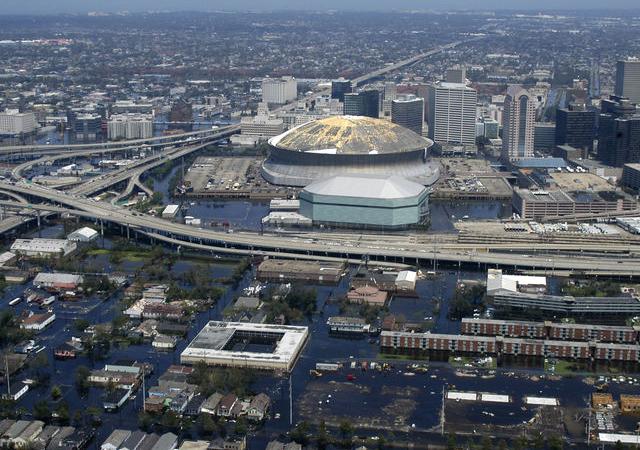
Cities Beneath The Sea (or Not): New Orleans

After Hurricane Katrina slammed into New Orleans on August 29, 2005, it was popular in news accounts to blame much of the damage on the fact that the city lay below sea level. This was more than an academic point, as it was common to ask why the city was built below sea level in the first place and why resources should be expended rebuilding it when it was inevitable the city would flood again. The basic assumptions behind those questions are not so simple.

What Is Sea Level? Websters defines sea level as "the position of the sea's surface at mean level between high and low tides." Mariners might be expected to have a more precise definition and turn to the American Practical Navigator, or "Bowditch," where sea level is defined as the "height of the surface of the sea at any given time." At first it might seem that Bowditch and Webster are talking about two different things, but the truth lies somewhere in between.

Sea level is not the same all over the world. The Caribbean Sea's level at the Panama Canal is eight inches higher than the Pacific Ocean's. Several reasons may account for this, including variations in the Earth's gravity field, salinity, and time required for the sea's surface to find equilibrium in a given volume. Whatever the cause, the Canal's builders were aware of it even a century ago and took the difference into account in their construction plans.

Sea level also varies over time. Tides run in 19-year cycles, thus the "mean" between high and low tides is going to vary during that cycle. In cases like New Orleans, where the elevation varies between 20 feet above sea level to nearly seven feet below sea level, whether a particular point on land is above or below sea level can depend on the given time within the tidal cycle.

Global climate also effects sea level. During the last Ice Age, worldwide sea levels were as much as 100 feet lower than they are today, when much of the planet's water was frozen into ice. Climate scientists say a warming climate has increase sea levels by as as much as a meter every 50 years.

New Orleans Is Below Sea Level. The United States Geological Survey puts the lowest point in Louisiana in the city of New Orleans at eight feet below sea level. Of the nation's 50 largest cities, 17 have areas at or below sea level. Of those, only Houston does not lie on a sea coast. Washington DC, with a minimum elevation of 1 foot, just misses making the list.

A city may have areas at sea level and not be in danger of flooding however. San Francisco and Seattle are both on the above list, for instance, but most of the inhabited areas of these cities lie well above sea level. As I write this, I am in Seattle a mile from the nearest beach, but 125 feet above sea level. Long Beach, California has spots as low as 7 feet below sea level, and as high as 360 feet above. On the other hand, a post-Katrina study by Tulane and Xavier Universities found that 51% of New Orleans was between sea level and 20 feet above.

New Orleans Is Above Sea Level. The Tulane and Xavier study pointed out that most of New Orleans's population lives in areas above sea level. The study also found that much of the area above sea level was under-utilized. This may be important, as New Orleans may be sinking. A report by the American Society of Civil Engineers found that the city my be sinking due to the natural settling of underlying soil, the pumping of groundwater and, ironically, the use of flooding control measures which prevent the natural replacing of silt and sediment by the Mississippi River.